01 Jun
GLDA in ADW Laundry Detergents Scale Prevention Cleaning Performance
Walk into any European supermarket—from Paris to Berlin to Milan—and the detergent aisle tells a story of change. Shelf after shelf displays products labelled "eco-friendly," "biodegradable," "phosphate-free," and "EU Ecolabel." Behind these labels lies a fundamental shift in detergent chemistry: the move away from persistent chelators like EDTA and phosphonates toward biodegradable alternatives.
But formulators face a critical challenge. A chelator must do more than just biodegrade. It must prevent scale in hard water. It must stabilise bleaches. It must keep enzymes active. It must work across automatic dishwashing (ADW) tablets, powder laundry detergents, and liquid formulations. And it must do all of this without compromising cleaning performance.
Enter GLDA (Tetrasodium Glutamate Diacetate) – a readily biodegradable, multi-purpose chelator that is rapidly becoming the new benchmark for European detergent formulations.
What Is GLDA? A Chelator Built on Nature’s Blueprint
GLDA (tetrasodium glutamate diacetate) is a chelating agent derived from L-glutamic acid – a naturally occurring amino acid found in plants, animals, and humans. Its molecular structure features two acetate groups attached to a glutamate backbone, creating a strong, stable binding affinity for calcium, magnesium, iron, copper, and other metal ions.
What makes GLDA exceptional for detergent applications is its unique combination of properties:
Excellent calcium binding capacity – effectively prevents scale even in very hard water (up to 30°dH and beyond)
Broad pH stability – works from acidic (pH 4) to highly alkaline (pH 13)
High solubility – remains stable in concentrated liquid formulations without crystallising
Biodegradability – readily biodegradable under OECD 301B (>60% in 28 days) and also biodegradable in freshwater and marine environments
Non-persistent – unlike EDTA, GLDA does not mobilise heavy metals in the environment
Why European Detergent Formulators Are Switching to GLDA
1. Superior Scale Prevention in Automatic Dishwashing
Scale – the white, chalky deposit left on glassware, dishes, and dishwasher interiors – is the number one consumer complaint in automatic dishwashing. Hard water contains calcium and magnesium ions that, under alkaline conditions and high temperatures, precipitate as calcium carbonate.
These deposits do more than look unsightly. They:
Reduce glass transparency – permanent etching can occur
Damage dishwasher components – heating elements, spray arms, and sensors
Interfere with cleaning – soil redeposition increases
Shorten appliance life – scale buildup reduces efficiency
GLDA effectively sequesters calcium and magnesium ions, keeping them in solution throughout the wash cycle. When the water is drained, the GLDA-metal complexes go with it – leaving no residue on dishes or machine parts.
In standardised testing (IEC 60436), ADW formulations containing GLDA consistently achieve scale prevention scores comparable to or better than EDTA-based systems, and significantly better than citrate-only or polymer-only systems.
2. Bleach Stabilisation for Consistent Stain Removal
Most European ADW detergents and many laundry powders rely on oxygen-based bleaches – typically sodium percarbonate or sodium perborate – activated by TAED (tetraacetylethylenediamine). These bleaches are highly effective against tea, coffee, red wine, and other organic stains.
However, trace metal ions – iron and copper – catalyse premature bleach decomposition. The result is:
Reduced stain removal – bleach is depleted before the main wash
Shorter product shelf life – degradation continues in the box
Fabric yellowing (laundry) – uncontrolled bleach causes damage
GLDA chelates these catalytic metal ions with high affinity. In fact, GLDA's iron chelation stability constant is among the highest of any biodegradable chelator. This ensures that bleach activates exactly when it should – during the wash cycle – delivering consistent, powerful stain removal from the first use to the last.
3. Enzyme Compatibility and Formulation Stability
Modern detergents rely heavily on enzymes – proteases for protein stains, amylases for starches, lipases for greases, and mannanases for food gums. These enzymes are sensitive to metal ions, which can denature them or reduce their activity.
GLDA stabilises enzyme systems by:
Removing free metal ions that could otherwise inactivate enzymes
Preventing metal-catalysed oxidation of sensitive formulation ingredients
Maintaining clear, homogeneous liquid formulations (no precipitation or phase separation)
For liquid laundry detergents – particularly compact or "super-concentrated" formulas – GLDA is exceptionally stable. It does not hydrolyse or crystallise over time, even at low temperatures or after freeze-thaw cycles.
4. Regulatory Compliance and Ecolabel Qualification
The European detergent market is one of the most regulated in the world. Key frameworks include:
EU Detergents Regulation (EC) No 648/2004 – requires biodegradability of organic ingredients
EU Ecolabel for Detergents (2017/1217) – restricts or prohibits EDTA and phosphonates
Nordic Swan Ecolabel – similar restrictions with preference for GLDA and MGDA
Blue Angel (Germany) – stringent criteria for persistent-free products
GLDA is fully compliant with all these frameworks. It is listed as a preferred chelator in EU Ecolabel criteria for both ADW and laundry detergents. For brands selling into German, Scandinavian, French, or Benelux retail channels, GLDA provides a clear pathway to ecolabel certification.
Additionally, GLDA is ZDHC (Zero Discharge of Hazardous Chemicals) compliant – a critical requirement for brands supplying the fashion and textile industry with laundry products.
Application Guidelines for GLDA in Detergents
Automatic Dishwashing (ADW) – Tablets and Powders
| Parameter | Recommendation |
|---|---|
| GLDA dosage (active) | 5–15% of formulation |
| Primary function | Scale prevention, bleach stabilisation, glass protection |
| Synergistic co-ingredients | Polycarboxylates, sodium citrate, TAED, percarbonate |
| pH range (wash liquor) | 9–11 |
| Water hardness tolerance | Effective up to 40°dH |
Laundry Detergents – Powders
| Parameter | Recommendation |
|---|---|
| GLDA dosage (active) | 1–4% of formulation |
| Primary function | Hardness control, bleach stabilisation, enzyme protection |
| Typical co-ingredients | Zeolites, sodium carbonate, TAED, percarbonate |
Laundry Detergents – Liquids
| Parameter | Recommendation |
|---|---|
| GLDA dosage (active) | 0.5–3% of formulation |
| Primary function | Metal ion control, enzyme stabilisation, formulation clarity |
| Typical co-ingredients | Non-ionic surfactants, borax, preservatives, enzymes |
Comparison with Traditional and Alternative Chelators
| Parameter | EDTA | Phosphonates (HEDP) | Citric Acid | MGDA | GLDA |
|---|---|---|---|---|---|
| Biodegradability (28d OECD) | Poor (<20%) | Very poor (<10%) | Readily (>80%) | Readily (>80%) | Readily (>80%) |
| Marine biodegradability | Poor | Very poor | Moderate | Good | Excellent |
| Phosphorus-free | Yes | No | Yes | Yes | Yes |
| Calcium binding (mg Ca/g) | ~220 | ~250–300 | ~80 | ~200 | ~210 |
| Iron chelation | Excellent | Good | Poor | Good | Excellent |
| Liquid formulation stability | Good | Good | Moderate | Good | Excellent |
| EU Ecolabel allowed | No | Restricted | Yes | Yes | Yes |
| Nordic Swan allowed | No | Restricted | Yes | Yes | Yes |
| ZDHC compliant | No | Restricted | Yes | Yes | Yes |
While phosphonates still lead on raw calcium binding numbers, their environmental persistence is increasingly unacceptable. Citrate is biodegradable but lacks the metal chelation strength needed for modern high-performance detergents. MGDA and GLDA are close competitors, with GLDA offering slightly better iron chelation and superior marine biodegradability.
European Success Stories
Case 1: German ADW Tablet Manufacturer
A leading German private-label ADW tablet producer reformulated their best-selling "eco" line in 2023, replacing a phosphonate/EDTA blend with GLDA as the primary chelator. Results:
Passed all IEC 60436 scale prevention tests with scores equivalent to the original formula
Achieved EU Ecolabel certification within four months
Consumer testing showed no difference in spotting or filming compared to the previous formulation
Retailer feedback: positive – the "biodegradable chelator" claim improved shelf positioning
Case 2: French Liquid Laundry Detergent Brand
A French brand specialising in hypoallergenic, eco-conscious liquid laundry detergents switched from EDTA to GLDA. They reported:
Improved enzyme stability (protease activity maintained >90% after 12 months at 25°C)
Clearer formulation appearance (no cloudiness or sediment)
Successfully obtained Nordic Swan Ecolabel
Positive consumer response to "readily biodegradable" messaging
Case 3: Italian Industrial Laundry Operator
An Italian industrial laundry serving hotels and restaurants switched their CIP (clean-in-place) detergent to a GLDA-based formulation. Results after six months:
No scale buildup on heat exchangers (previously required monthly descaling)
Reduced detergent consumption by 8% (improved efficiency)
Lower wastewater treatment costs – GLDA biodegrades completely in their on-site plant
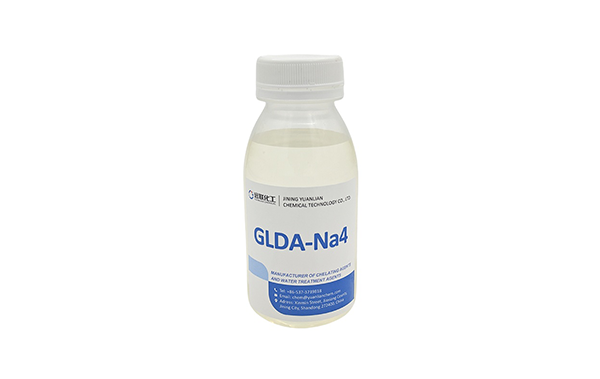
Consistent raw material quality is critical for these transitions. Yuanlian Chemical produces high-purity GLDA (tetrasodium glutamate diacetate) meeting EU detergent specifications, with:
38% active content (liquid grade)
Low heavy metal residuals (Fe, Cu, Ni below strict limits)
Batch-to-batch consistency with COA documentation
Non-hazardous transport classification – simplifies logistics
Several European detergent blenders have already qualified Yuanlian GLDA as an approved source.
FAQ – Optimised for Voice Search and Formulator Questions
Is GLDA as effective as EDTA for scale prevention?
Yes.
In hard water conditions typical of Europe (10–30°dH), GLDA performs
equivalently to EDTA at similar active dosages. At very high hardness
(>35°dH), slightly higher GLDA levels may be needed, but the
difference is small.
What is the difference between GLDA and MGDA?
Both
are biodegradable chelators based on amino acids. GLDA (glutamate
diacetate) has four carboxyl groups; MGDA (methylglycinediacetic acid)
has three. In practice, GLDA offers slightly better iron chelation and
superior marine biodegradability. Both are excellent choices; the
decision often comes down to cost and specific formulation
compatibility.
Does GLDA work in dishwasher tablets with bleach?
Yes.
GLDA is fully compatible with TAED-activated percarbonate systems and
actually protects the bleach from premature decomposition, improving
shelf life and cleaning consistency.
Is GLDA safe for septic tanks and greywater systems?
Yes.
GLDA is readily biodegradable and does not inhibit the bacteria in
septic systems or greywater treatment plants. Unlike EDTA, it does not
persist or mobilise heavy metals.
Can GLDA replace phosphonates completely in an ADW formula?
In
most European water conditions, yes. However, some formulators in very
high-hardness regions (e.g., parts of the UK with >35°dH) choose to
use a small amount of phosphonate alongside GLDA. Complete replacement
is achievable with optimised dosing.
What is the cost comparison between GLDA and EDTA?
GLDA
is typically 15–30% more expensive than EDTA on a raw material basis.
However, when you factor in regulatory risk, ecolabel qualification
(which enables premium pricing), and consumer preference for sustainable
products, the total cost of ownership is often lower or comparable.
Beyond Dishwashing and Laundry: Other GLDA Applications
Hard Surface Cleaners
GLDA at 0.5–2% improves soil suspension and prevents streaking on glass, mirrors, and stainless steel. It is particularly effective in bathroom cleaners where soap scum (calcium stearate) is a problem.
Car Wash Detergents
In automatic car wash formulations, GLDA prevents spotting on painted surfaces and is compatible with wax and polymer sealants.
Industrial and Institutional Cleaning
GLDA is widely used in CIP cleaners, bottle washing, and food processing sanitation where scale removal and equipment protection are critical.
Conclusion: GLDA Is the Future of Sustainable Detergent Chelation
European detergent formulators face a clear choice: continue using persistent chelators like EDTA and phosphonates and risk regulatory action, consumer rejection, and ecolabel exclusion – or switch to biodegradable alternatives that deliver equal or better performance.
GLDA (tetrasodium glutamate diacetate) is not just a "green" option. It is a high-performance chelator that maximises scale prevention, stabilises bleaches, protects enzymes, and ensures formulation stability – all while meeting the strictest environmental criteria.
Actionable recommendations for formulators:
Run a comparative test – Replace your current chelator (EDTA, phosphonate, or even MGDA) with GLDA at equivalent active levels.
Measure scale prevention and bleach stability – Use standard industry methods (IEC 60436 for ADW, bleach activity tracking for laundry).
Check your ecolabel eligibility – Switching to GLDA may qualify your product for EU Ecolabel or Nordic Swan.
Assess total formulation cost – Include regulatory risk mitigation, marketing value, and waste treatment benefits.
Source from a trusted supplier – Consistency matters. Yuanlian Chemical offers EU-compliant GLDA with full batch traceability.
The shift away from persistent chemicals is accelerating across Europe. Brands that move early to GLDA will not only avoid disruption – they will gain a competitive edge in the fastest-growing segment of the detergent market: sustainable, high-performance cleaning.
Aktuelle Nachrichten
Need help
Prefer speaking with a human to filling out a form? call corporate office and we will connect you with a team member who can help.